The Eiffel Tower and the 1889 World's Fair
Paris marked the centenary of the French Revolution with the Exposition Universelle, and Gustave Eiffel's iron tower was built as its entrance arch. At 300 metres it became the tallest structure in the world. Some 32 million people visited the fair, which showcased electric light, the phonograph and engineering from across the globe.
See it on the globe
What happened
In 1889 France marked the hundredth anniversary of the storming of the Bastille with the Exposition Universelle, a world's fair on the Champ de Mars that drew some 32 million visitors between May and October. Its centrepiece was Gustave Eiffel's iron tower, built as the fair's entrance arch in just over two years.

At 300 metres it was the tallest structure in the world, and many Parisian artists and writers signed a public protest calling it a useless and monstrous eyesore. The tower was only meant to stand for 20 years; it survived because it proved useful as a radio antenna.
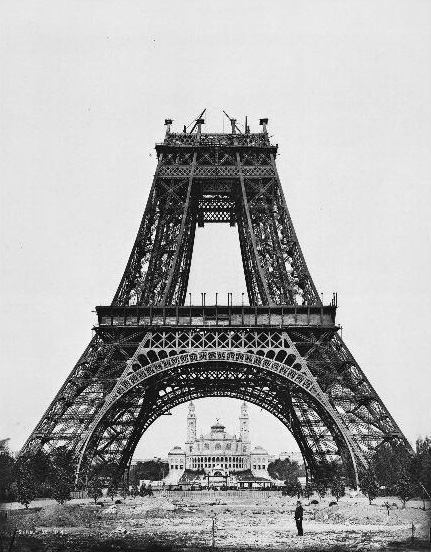
Beside it stood the Galerie des Machines, an enormous hall of glass and steel spanning 115 metres without internal supports, where visitors could ride moving walkways above working engines. The fair showcased Thomas Edison's phonograph, electric lighting after dark, and a 'human zoo' of colonial villages that reflects the imperial attitudes of the age. Together they made Paris the shop window of a confident, industrial and colonial Europe.
Around the same time
- Krakatoa erupts, Sunda Strait, Dutch East Indies, 1883
- The first modern Olympic Games, Athens, Greece, 1896
- The San Francisco earthquake and fire, San Francisco, USA, 1906
- The Panama Canal opens, Panama Canal Zone, 1904 to 1914
Earlier: Krakatoa erupts, 1883 · Later: The first modern Olympic Games, 1896
Further reading
Encyclopedia article: Exposition Universelle (1889) (en.wikipedia.org)