The Wall Street Crash
After years of speculation the New York Stock Exchange collapsed in late October 1929, with Black Thursday and Black Tuesday wiping out billions of dollars in days. The crash helped tip the world into the Great Depression, the deepest economic downturn of the industrial age.
See it on the globe
What happened
Through the 1920s the US stock market seemed to go only one way. Ordinary Americans bought shares 'on margin', borrowing most of the price, and the Dow Jones Industrial Average rose more than fivefold between 1921 and its peak in September 1929.

In late October confidence broke. On Black Thursday, 24 October, a record 12.9 million shares changed hands as prices plunged, and crowds gathered outside the New York Stock Exchange on Wall Street. Leading bankers bought stock to steady the market, but on Black Monday and Black Tuesday, 28 and 29 October, the selling resumed and billions of dollars of value vanished in two days.
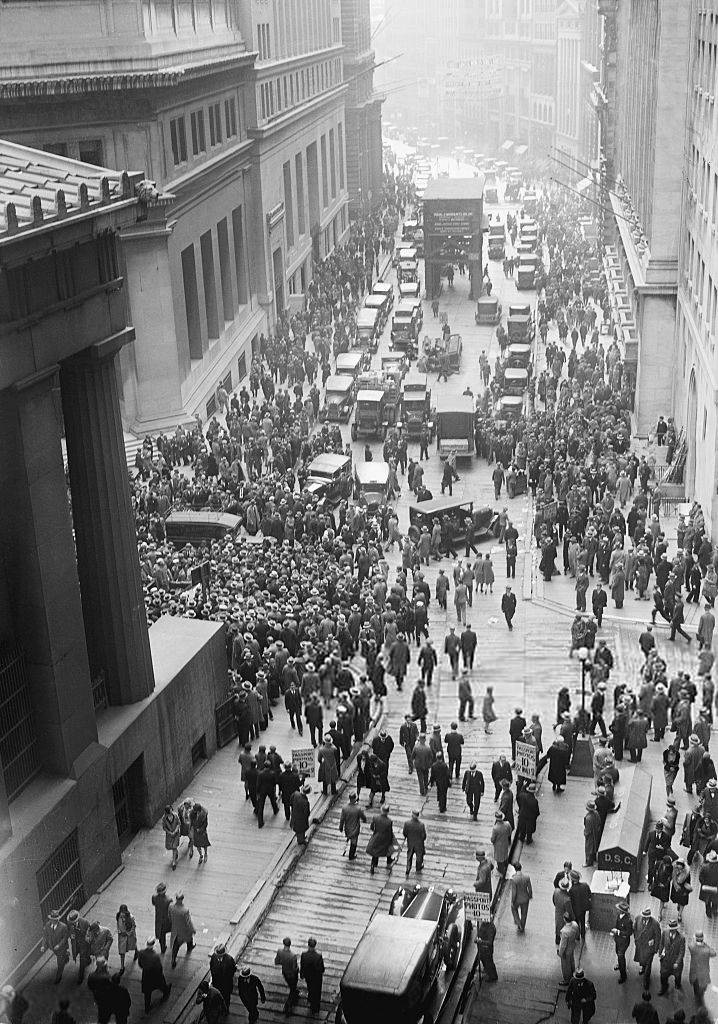
The crash did not cause the Great Depression on its own, but it wiped out savings, shattered confidence and exposed a fragile banking system. Thousands of banks failed over the next three years, US unemployment reached about 25% by 1933, and the downturn spread worldwide through trade and debt. The market did not regain its 1929 peak until 1954.
Around the same time
- The Golden Twenties, Berlin, Germany, 1924 to 1929
- The Dust Bowl, Southern Great Plains, USA, 1930 to 1936
- The Russian Revolution, Petrograd, Russia, 1917 to 1918
- The Battle of the Somme, Somme, France, 1916
Earlier: The Golden Twenties, 1924 to 1929 · Later: The Dust Bowl, 1930 to 1936
Further reading
Encyclopedia article: Wall Street crash of 1929 (en.wikipedia.org)