The Golden Twenties
Once the hyperinflation of 1923 was tamed, Weimar Germany entered a brief boom. Berlin became one of the liveliest cities in Europe, with cabaret, jazz, Bauhaus design, expressionist film such as Metropolis and a newly open nightlife. The Wall Street Crash of 1929 brought the era to an abrupt end.
See it on the globe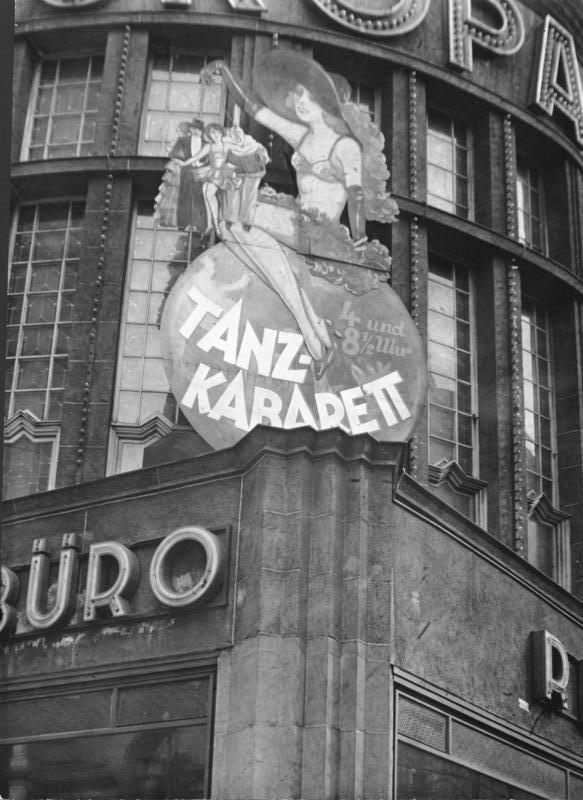
What happened
Germany emerged from the First World War defeated, burdened with reparations, and wracked by uprisings. By November 1923 hyperinflation had made the mark worthless: a loaf of bread cost billions. A new currency, the Rentenmark, and American loans under the Dawes Plan of 1924 finally stabilised the economy and opened a short golden age.

For the next five years Berlin, a city of four million, was one of the most exciting places in Europe. Cabarets and jazz clubs lined the streets around Friedrichstrasse and Kurfürstendamm, and the city's nightlife became famous for its openness, including for gay and lesbian Berliners. Artists such as George Grosz and Otto Dix painted its contradictions, Bertolt Brecht and Kurt Weill premiered The Threepenny Opera in 1928, and studios at Babelsberg made films like Fritz Lang's Metropolis. Bauhaus designers, based nearby in Weimar and then Dessau, reshaped architecture and everyday objects.

Beneath the glamour, the Weimar Republic remained fragile, attacked by communists and nationalists alike. When the Wall Street Crash hit in 1929, American loans were recalled, unemployment soared, and within four years Hitler was in power.
Around the same time
- The Wall Street Crash, New York City, USA, 1929
- The Dust Bowl, Southern Great Plains, USA, 1930 to 1936
- The Russian Revolution, Petrograd, Russia, 1917 to 1918
- The Battle of the Somme, Somme, France, 1916
Earlier: The Russian Revolution, 1917 to 1918 · Later: The Wall Street Crash, 1929
Further reading
Encyclopedia article: Golden Twenties (en.wikipedia.org)